£170m London Gateway High-Bay Depot Puts Vertical Container Storage on the Map
London Gateway's £170m, 27,000-TEU automated high-bay empty-container warehouse marks vertical port storage's move from pilot to commercial market — but adoption stays selective, driven by land scarcity, not trade growth.
Adjustments
- London Gateway announced a £170m automated high-bay warehouse in October 2025, designed for up to 27,000 TEU across 16 levels.
- BOXBAY's Jebel Ali pilot (792 slots, 11 levels) reported cumulative throughput of about 500,000 TEU by October 2025.
- Global port container throughput hit roughly 920 million TEU in 2024, up 6.9 percent year on year.
- The Busan project targets 350,000 avoided container movements annually and a 20 percent truck-handling improvement.
- ZPMC described automated empty-container storage concepts of up to 18 levels in 2026.
A £170 million automated high-bay warehouse for empty containers, announced at London Gateway in October 2025, has pushed vertical port storage out of the pilot phase and into a commercial infrastructure market. The facility is designed to hold up to 27,000 TEU across 16 levels in an enclosed building, with construction pegged at just over two years.
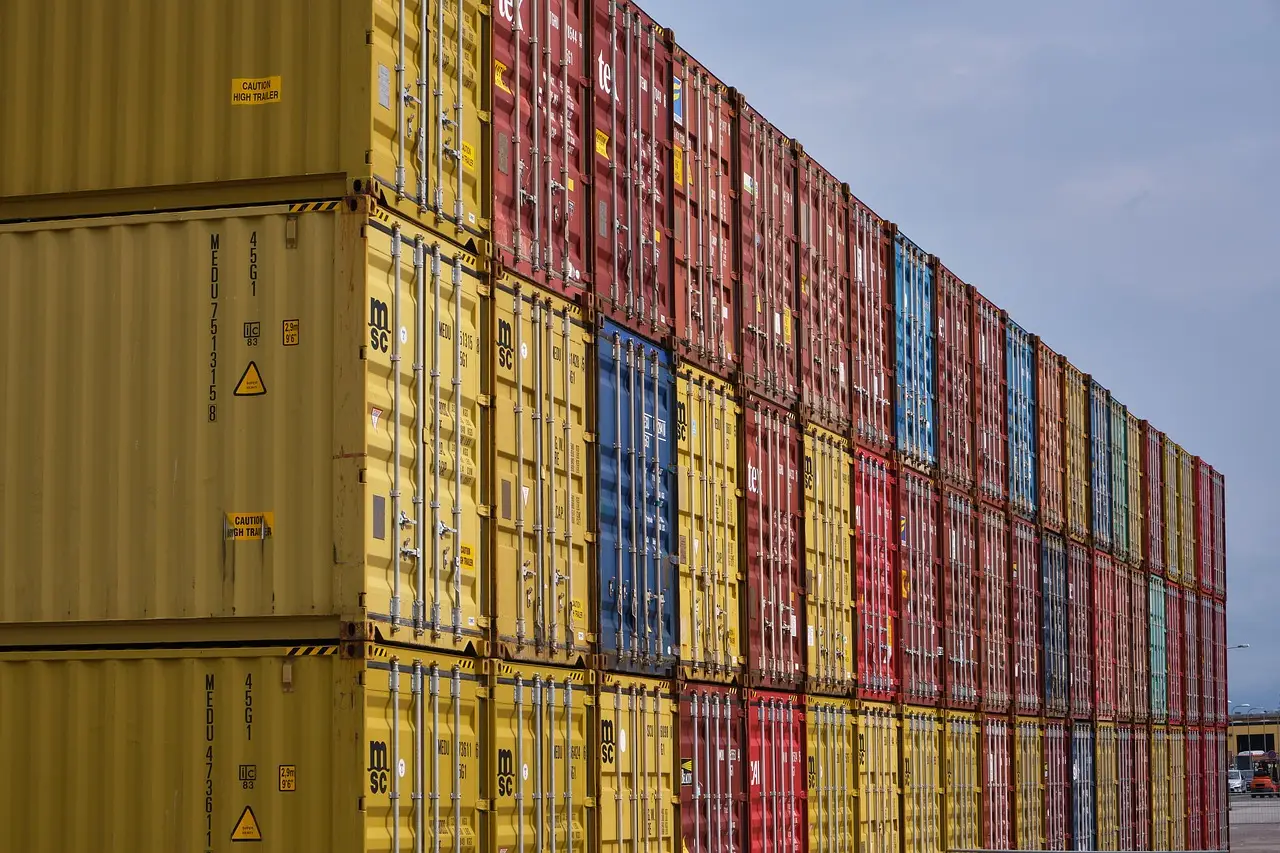
That's the anchor of a wider shift. By 2026, container high-bay warehouses — containers stored in a load-bearing racking structure with automated retrieval, each box in its own slot — have moved from concept to early commercial deployment. Widespread adoption hasn't arrived, and the market remains a handful of large projects rather than a wave.
What does the London project actually prove?
The investment implies roughly £6,300 per TEU of nominal storage capacity — a derivation from published figures, not a stated plant price. It's not clear how the £170m splits across building, structure, craneing, control systems and integration, and storage capacity (an inventory) can't be equated with annual throughput (performance over time).
The design uses double-deep storage: two bays in line, so the rear slot isn't independently accessible. For empty containers grouped by owner, size and type, that trade-off can work. Loaded boxes — driven by individual delivery dates, weights and handling requirements — are a different economic case, so an empty-depot win doesn't automatically transfer to full-container racking.
Where did the technology come from?
BOXBAY, a joint venture between DP World and SMS group, supplied the proof. Its Jebel Ali pilot, commissioned in early 2021 with 792 container slots across 11 levels in a steel structure, logged more than 63,000 container movements by August that year. By October 2025 the trial reported cumulative throughput of about 500,000 TEU. BOXBAY claims comparable capacity on roughly one-third the footprint of conventional stacking — a system-specific benchmark, not a universal figure.
Other players are circling with different architectures:
- ZPMC described automated empty-container systems of up to 18 levels in 2026, but with containers still partly stacked directly on top of each other, so access requires relocations.
- LTW Intralogistics designed a depot in Emmen with around 600 container spaces, 18-tonne payload and technical redundancy — a reliability play, not a throughput play.
- Busan's Pusan Newport Corporation terminal project targets 350,000 avoided unproductive movements annually and a 20 percent cut in truck handling time. These are stated targets, not verified results.
- Brisbane's port vision flags high-density vertical storage as a possible answer to future space constraints — strategic interest, not a committed investment.
Why is demand there at all?
Ports handled roughly 920 million TEU worldwide in 2024, up 6.9 percent year on year and up 37 percent since 2014 — though throughput counts a transshipped box at every port of call, so it measures infrastructure utilisation, not cargo volume. A maritime transport assessment published in late November expects overall maritime trade to stagnate while containerised trade grows 3.3 percent in 2026, after 5.3 percent projected for 2025.
Trade geography is shifting too: container trade between developing countries grew 12.1 percent in 2025 to a 14.2 percent share, while the major East-West routes managed only 0.9 percent. But the real driver for vertical storage is local — full yards, long-dwell empties and peak-load congestion, not a single global growth rate.
The core benefit is decoupling storage capacity from land. A racking system shifts capacity vertically, and freed-up space can absorb traffic, add storage or postpone expansion. Density isn't throughput, though: if gates, rail or cranes are already saturated, extra storage sits partly unused.
London Gateway plans fully electric storage and retrieval machines, with energy recovery. The Busan concept includes rooftop photovoltaics — which doesn't guarantee self-sufficiency, since generation and demand rarely coincide.
What's the outlook to 2030?
Expect growth through a few large reference projects rather than a mass market, with multi-year build times blurring the line between announced investment and commissioned capacity. No reliable global revenue figure exists for the narrow segment, and published forecasts that lump together all automated warehousing or port machinery can't be extrapolated to it.
The base case is selective deployment: empty-box applications where land is tight, plus specialised depots where orderly access and reliability carry a premium. Acceleration requires the first large-scale plants to prove availability, integration cost and life-cycle economics; a cautious scenario sees conventional automated block storage — which already fits most operating models — take part of the market back.
The likely end state is a hybrid terminal, with racks handling compact, order-sensitive inventory and conventional or automated open yards doing the rest, stitched together by control software. The winners sell integration, not stacking height.
via Google News: Ports & Terminals (Source)
More from Sophie Lindqvist
Show full bio
Market editor covering technology and product news in commercial shipping for industry professionals at Vessels.
187 articles
Linked entries
- COSCO pays RMB570m for 146 hectares to build Tianjin mega-yard
- Northwest Seaport Alliance Volumes Slide 9.6% to 2.4m TEU
- Port of Blyth unveils 3-hectare plan and 1m channel deepening
- ABP completes £7m build-to-suit warehouse at King's Lynn for Azelis
- Chennai woos Taiwanese carriers with $1.88bn terminal pitch