Korea's Big 3 Pivot to Offshore Plants as FPSO Orders Loom
Korea's ship exports are forecast at $33.6bn this year as HD Hyundai Heavy, Samsung Heavy and Hanwha Ocean push into FPSO and FLNG work to offset a commercial ship slowdown and China's price push.
Adjustments
- Korean ship exports forecast at $33.6bn in 2026, up from $31.8bn in 2025, an eight-year high.
- Samsung Heavy has won 7 of 11 FLNG units built worldwide since the early 2000s.
- Clarksons forecasts 11 new FPSO contracts in each of 2027 and 2028.
- Big 3 won 46 of 79 LNG carriers (58%) and 65 of 103 VLGC/VLAC orders (63.1%) ordered this year.
- China's Wison has won three FLNG orders; HD Hyundai Heavy signed $467.4m and $712.5m U.S. power contracts this year.
South Korean ship exports are forecast to reach about $33.6bn this year, up from $31.8bn in 2025 — an eight-year high — as the country's Big 3 yards push offshore plants to offset a slowing commercial ship market and counter China's price-driven chase.
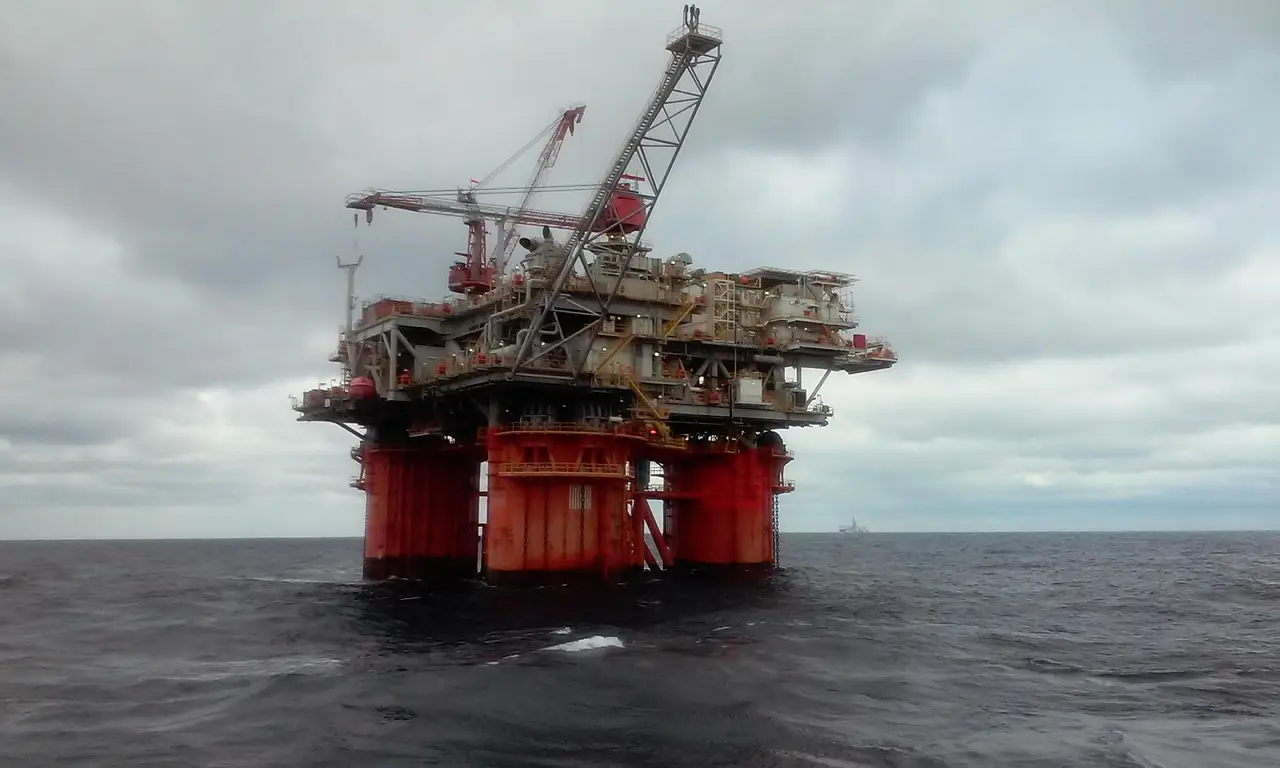
HD Hyundai Heavy Industries, Samsung Heavy Industries and Hanwha Ocean are widening their portfolios from merchant tonnage into floating production, storage and offloading (FPSO) units and floating liquefied natural gas (FLNG) facilities, betting that high oil prices and tighter environmental rules will drive orders through the decade.
How large is the expected order pool?
Clarksons Research forecasts 11 new FPSO contracts in each of 2027 and 2028, driven by demand to diversify crude supply chains as the Middle East conflict drags on. LNG-linked FLNG orders are expected to keep flowing, centred on Brazil, West Africa, Venezuela, Mozambique and Nigeria.
A shipbuilding industry official said the push reflects an effort to diversify portfolios by nurturing businesses with different cycles rather than relying solely on commercial vessels.
Where does each yard stand?
- Samsung Heavy Industries has run its offshore plant business most consistently, keeping it alive through the oil-price downturn when rivals exited drillships and jack-up rigs. It has won 7 of the 11 FLNG units built worldwide since the early 2000s. A company official said the shift toward lower-carbon LNG is accelerating as environmental regulations tighten. It is also an early leader in floating data centers (FDC).
- Hanwha Ocean is pursuing FPSO and FLNG sales with standard design models, since offshore projects run long cycles from order to delivery. A company official said it developed a standard FPSO design tailored to specific sea-area conditions this year, securing price competitiveness ahead of a full-scale order battle. It has not won an FLNG order since its days as Daewoo Shipbuilding & Marine Engineering, but early re-entry moves have been detected.
- HD Hyundai Heavy Industries reorganised its offshore business, launching an Offshore Energy Business Division in May 2024 covering offshore plants and renewable energy. In July, HD Korea Shipbuilding & Offshore Engineering (KSOE) signed an MOU with Schneider Electric to jointly develop floating data center infrastructure technology. It also supplies floating bodies for offshore wind turbines and offshore substations at home and abroad.
Who is the competition?
China and Singapore remain the key variables. China's Wison has already won three FLNG orders, and CIMC Raffles — China's largest offshore plant equipment maker — is highly competitive. An industry official said China is a potential competitor in offshore plants as well, calling its manufacturing-wide push an unavoidable trend.
What holds up the commercial backlog?
LNG carriers and gas carriers lead. Of the 79 LNG carriers ordered worldwide through mid-June, Korea's Big 3 won 46, or about 58%: KSOE and Samsung Heavy took 19 each, Hanwha Ocean 8. Of the 103 VLGCs and VLACs ordered globally through last month, the Big 3 won 65, or 63.1%, with KSOE alone taking 53 — 51.5% of world orders.
Export figures confirm the trajectory: $21.8bn in 2023, $25.6bn in 2024, $31.8bn in 2025, with imports of about $4.6bn yielding a trade surplus of roughly $27.2bn — 35% of Korea's total surplus of about $78bn.
What lies beyond ships?
The yards are opening post-boom markets. HD Hyundai Heavy and Hanwha Ocean have entered the U.S. Navy's maintenance, repair and overhaul (MRO) business, servicing logistics support ships; Hanwha Ocean will build on Philly Shipyard, while HD Hyundai Heavy works through a JV with U.S. EPC firm Keewit.
In power generation, HD Hyundai Heavy signed contracts this year worth Won627.1bn (about $467.4m) with Aperion Energy Group and Won956bn (about $712.5m) with Kovan Energy Group, both U.S. companies. Samsung Heavy is pursuing a 50-megawatt-class floating data center with a U.S. partner, and Hanwha Ocean is working with ABB on floating power plants (BMPP).
The counter-cyclical logic is simple: commercial vessels and offshore plants have different order cycles, offsetting market swings. With Chinese players pressing on price and technology, Korean yards' remaining route is differentiation through standard designs and high-value-added facilities.
via Google News: Shipbuilding (Source)
More from Rebecca Stone
Show full bio
News editor covering people, launches and day-to-day practice in commercial shipping for industry professionals at Vessels.
128 articles
Linked entries
- South Korean ship exports forecast at $33.6bn, an eight-year high
- Korean LNG insulation duopoly eyes US export project windfall
- Big Three Korean Yards Spend 437.7 Billion Won on R&D in Nine Months
- Samsung Heavy Eyes India Build Capacity as Korean Yards Sell Out to 2028
- VLCC deliveries jump fivefold as 349-ship orderbook builds